How AI Is Changing the MSP Model (And What It Means for SMB Clients)
AI and the MSP model: service desk agents in Slack and Teams, summarized security incidents, managed AI connectors, and more strategic time for SMB clients.

Guides on managed IT, security, identity, Slack support, SOC 2 and AI tooling for startups and SMBs.
AI and the MSP model: service desk agents in Slack and Teams, summarized security incidents, managed AI connectors, and more strategic time for SMB clients.
Clio Manage AI features, App Directory permissions, and remote MCP connectors that bring Clio matter data into ChatGPT and Claude with per-user OAuth access.

Claude Desktop install errors on macOS, Windows, and Linux with the documented fix for MDM updates, missing HCS services, apt key errors, and Cowork checks.

n8n workflows for IT teams: provision new hires into Google Workspace from a form, post Slack alerts on service problems, and catch every workflow failure.

OpenRouter gives SMB AI apps one OpenAI-compatible client for every major model, with automatic fallbacks, provider routing, per-key spend caps, and guardrails.

Jira Service Management custom domains: request one in Atlassian Administration, add the CNAME records, activate it, and fix the common errors.

AI in IT support resolves routine tier-one work. Access approvals, incident calls, security exceptions, and vendor choices still need a named human owner.

Claude Projects, Google Search Console, and PageSpeed Insights combine into a repeatable AI website audit that scores every page for search and AI answers.

Confluence runbook templates and a Rovo agent turn IT procedures into instant self-service answers: template setup, runbook structure, agent knowledge, upkeep.

Reusable team prompts in Claude and ChatGPT shared projects: a four-part prompt pattern, sharing permissions, version testing, and three starter prompts.

Jira Service Management forms: build conditional sections, link questions to Jira fields and Assets objects, and attach one intake form to each request type.

Jira API tokens and Jira Cloud backups: create scoped personal and service account tokens, run Backup manager, and restore with a clear view of what returns.

Jira admin handover checklist: document workflows and automations, reassign filters and dashboards, move API tokens to service accounts, and audit week one.

AI workflows for small teams: inbox triage in Gmail and Outlook, meeting notes that become assigned tasks, Slack recaps, and answers from your own docs.

AI adoption pilot costs broken down: Microsoft 365 Copilot and Claude Team seat prices, the configuration hours that dominate them, and a 30-60-90 shape.

Guest access across Slack, Google Workspace, Jira, and Notion: use the free guest tiers, time-box every account, and run a review cadence that holds.

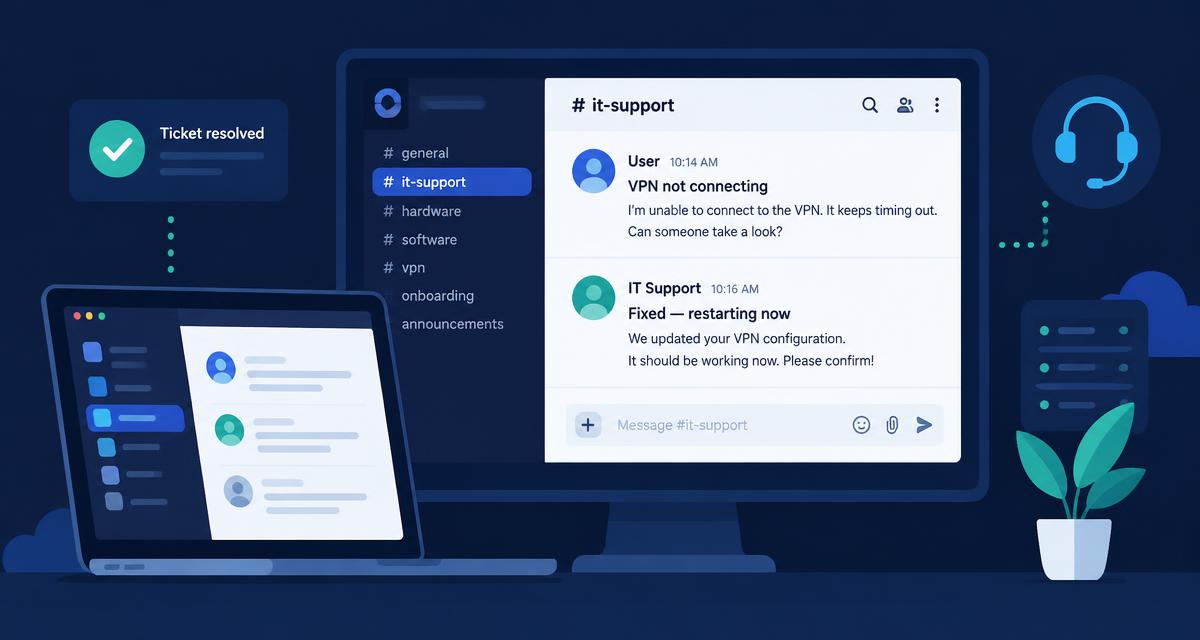
Slack-first IT support captures every request as a ticket without a portal form, and AI triage resolves the routine ones in the thread where they were asked.
AI amplifies the IT process you already run. Settle intake, named request types, knowledge articles, and closure criteria before you automate a service desk.

Clio and Jira sync through Zapier: create one Jira issue per new matter, share status both ways, and block duplicates and loops with linked ID fields.
Slack admin settings for SMBs: enforce 2FA, require approval for invitations and apps, control channel permissions, and set default channels and retention.

SOC 2 explained for startups: the five Trust Services Criteria, Type I vs Type II, and the controls to have in place before your first audit.

Incident response plan template for SMBs: severity levels, named roles, a first-hour runbook, and the tabletop exercise that keeps it followed.

The IT stack ladder from 10 to 100 employees: how identity, service desk, device management, security, and SaaS controls should grow with headcount.

Least privilege for your SaaS stack: assign apps by group in Okta, scope Google Workspace admin roles, and set access reviews that keep grants current.

Security policies for startups: the eight foundational documents to write before employee 25, from acceptable use to incident response and SaaS review.

Microsoft Entra ID vs. Okta for SMBs: current pricing, Microsoft 365 and Google Workspace fit, app integrations, provisioning, and which to pick for your stack.

Okta provisioning for Google Workspace: authenticate the API integration, enable create, update, and deactivate, and new hires get accounts on day one.

A managed service provider runs your startup's IT for a fixed monthly fee: service desk, identity, devices, SaaS admin, and security. Here is what you get.

Zero trust explained for SMBs: verify every request with identity and device checks, and build it from the SSO, MFA, and MDM tools you already run.

In-house IT vs MSP costs for a 50-person company: BLS salary data against per-user pricing, the overhead a salary hides, and when each model wins.

Okta SSO setup for startups: add apps from the Okta Integration Network, choose SAML or OIDC, and assign by group so new hires get access on day one.

Okta security audit in five checks: super admin count, MFA enforcement, session lifetimes, ThreatInsight blocking, and HealthInsight's own task list.

Managed IT provider onboarding in 90 days: stack discovery, early security wins, a service desk your team adopts, and a written roadmap with owners.

Managed IT support pays for itself in founder hours, faster fixes, security posture, and license savings. The real costs of running without it, itemized.

SOC 2 readiness in 90 days: how a 20-person SaaS company implemented every Security control with outsourced IT while founders stayed on the product.

How to roll out multi-factor authentication company-wide: open enrollment in Google Workspace, Entra ID, or Okta, set a date, enforce, and time-box exceptions.

The quarterly IT security checklist for SMBs: access reviews, MFA coverage, offboarding reconciliation, device compliance, and a real backup restore test.

Slack's Casey support-agent sample plus a Claude API key gives you an AI IT support bot: scaffold it with the Slack CLI, add your key, and test in an hour.

Remote-first IT onboarding checklist: create the identity first, ship MDM-enrolled laptops, provision apps by group, and verify on a day-one call.

Okta SOC 2 setup in five Admin Console steps: required MFA, a locked Admin Console, capped sessions, ThreatInsight enforcement, and HealthInsight evidence.

Google Workspace autoprovisioning turns new hire setup into one account and one group: SSO and SCIM push accounts to Slack, GitHub, and the rest.

How to set up Jira for a first-time team: create a team-managed space from the Kanban template, invite people, and shape the board around real work.

Startup IT strategy in five day-one decisions: one identity provider, default tools per function, automated onboarding, a one-page plan, and what to outsource.

Jira project templates matched to startup teams: Kanban and Scrum for engineering, IT service management for ops, and service intake for marketing.

Jira Service Management as your internal IT help desk: create the service space, add agents, open the portal, connect email, and build triage queues.

SaaS spend reduction for SMBs: one subscription inventory, reclaimed idle seats, collapsed duplicate tools, and renewals bought deliberately.

Google Workspace, Slack, 1Password, Jira, Notion, HubSpot, QuickBooks, Claude: the standardized SaaS stack for SMBs, with the reasoning behind each pick.

Enterprise IT on a startup budget: one identity for every login, policy-managed devices, a real service desk, and the managed route to all four layers.

Enterprise IT practices sized for startups: role-based access, policy-enforced security baselines, named owners, one asset inventory, deliberate changes.

The five IT decisions that set a startup up to scale: one identity provider, managed IT support, device management, a standard stack, and a service desk.

Google Workspace Admin console setup for SMBs: enforce 2-Step Verification, turn on DKIM, lock down Drive sharing, and five more settings built to scale.

AI-native managed IT resets the checklist for choosing a provider: automated resolution, self-running onboarding, and safe AI adoption for your team.

Startup IT underinvestment is a rational pattern with a fixable cause. The short foundation list worth building before an incident sets the schedule.

Jira Service Management's virtual service agent answers tier-one tickets from your knowledge base. The setup steps, prerequisites, and checks to run first.

AI agents let a two-person IT team cover a whole company: the practices that put agents on the tier-one queue with permissions the team already controls.

Claude connectors plus Jira Service Management AI answers: enable them org-wide, connect your tools, set permissions, and let AI resolve routine IT requests.

Endpoint security for a remote team: device enrollment, enforced encryption, EDR, and identity-tied access, deployed by policy from the first laptop.

Microsoft 365 tenant hardening in four moves: security defaults, the Standard email preset, the unified audit log, and a trimmed admin role list.

Automated IT alerts for a small team: the Microsoft 365 and Google Workspace notifications to switch on, what to monitor externally, and how to route pages.

Jira automation flows that handle repetitive ticket management: auto-assignment, stale-ticket sweeps, and SLA escalations, with exact setup steps.

The IT stack a 10-person startup should set up first: identity provider, email authentication, password manager, device baseline, and a shared knowledge home.

IT offboarding checklist for Microsoft 365, Google Workspace, and Slack: end sessions, block sign-in, transfer data, and verify every account is closed.

Self-service password reset in Microsoft Entra ID and Google Workspace: enable it, require registration, and deflect the reset tickets that remain.

Five repetitive IT tasks worth automating this quarter: account provisioning, password resets, ticket triage, device patching, and SaaS license reviews.

Claude API triage for IT help desks: wire Jira Service Management automation to set priority, category, and a summary before a human opens the ticket.

Automated employee onboarding for SMBs: wire your HR system to Okta, provision apps with SCIM, enroll devices zero-touch, and let AI draft the rest.

IT maturity model for startups: four stages from ad hoc accounts to strategic operations, plus the signals that place your company on the curve.

SOC 2 for SaaS startups as a timeline: gap assessment, closing IT gaps, evidence automation with Vanta or Drata, and the Type I and Type II audits.

ScaleIt's first 30 days of managed IT, week by week: stack inventory, MFA enforcement, automated onboarding and offboarding, and monthly reporting.

How to choose an MSP: seven questions on onboarding, SLA tiers, provider security, data ownership, AI automation, and reporting to ask before you sign.

The SaaS setup review an MSP runs on day one of an engagement: app inventory, identity and MFA, offboarding flows, license spend, and data ownership.

Namecheap, Cloudflare Email Routing, and ImprovMX compared: free-tier limits, DNS requirements, and sending options for custom-domain email forwarding.

IT support keeps today running; IT strategy decides where the stack goes. What each layer covers and how SMBs fund both without two full-time hires.

The first AI workflow to automate at a 10-person company is email triage and draft-reply generation. Here is how to pick and ship it this week.

Vendor-hosted AI is the right starting point for most startups and SMBs. Here is how vendor APIs and self-hosting compare on cost, compliance, and control.

Operations infrastructure hits predictable stress points at 25, 50, and 100 employees. Learn what to build before each threshold to scale without friction.

Unmanaged ChatGPT use exposes companies to data leakage, hallucination risk, and IP uncertainty. How to allow productive use with a clear policy.

Six operations tools every SMB should have in place: identity, finance, comms, docs, ticketing, and security. Specific product picks for each category.

Measure ROI on the AI tools you already pay for: establish baselines, track time saved, calculate monthly value, and make a keep-or-cut decision at 90 days.

Run a fire drill before a real incident hits: define severity levels, assign roles, build a one-page runbook, and run a tabletop exercise with your team.

Hiring an AI consultant vs DIY: decision criteria on when outside expertise pays off, when internal capability makes sense, and what most SMBs choose.

SaaS renewal management: five practices to recover budget, right-size licenses, and negotiate better rates before annual contracts auto-renew.

Five steps for rolling out AI training to non-technical employees: tool selection, task mapping, hands-on practice, a prompt library, and a 30-day follow-up.

A clear AI policy sets consistent rules for AI tool use at your company. Here's how to draft, review, and distribute one in three to five days.

How to move Jira issues between projects while preserving history, attachments, and links. Covers status mapping, epic hierarchy, and sprint reassignment.

A step-by-step framework for auditing your IT spend, mapping it into four budget categories, and deciding what to manage in-house versus outsource.

Seven AI tools quietly winning at SMBs: Clay for prospect enrichment, Fireflies.ai for meeting intelligence, Ramp for spend visibility, and four more.

A well-organized Slack workspace feels calm. People know where to post, messages don't disappear into ignored channels, and important decisions stay

Ops and tech debt grows with every sprint that passes. Which categories compound fastest, when to defer, and how to identify what to fix first.

Jira Cloud cleanup playbook for orphaned projects: audit steps, archive vs. trash decision, exact UI paths, and permission requirements for admins.

An MSP outperforms a dedicated IT hire for most startups and SMBs. Here are the thresholds where in-house IT becomes the more cost-effective choice.

Thirty minutes with one AI tool is enough to see what it can do. How to pick a starting point, run two real tasks, and build the habit from there.

Ten tools every new SMB should configure first: identity, password manager, storage, communication, project tracking, helpdesk, video, MDM, eSignature, and AI.

Six signs your Jira instance needs a configuration reset: workflow sprawl, custom field bloat, permission gaps, broken reports, and a backlog nobody trusts.

A managed services plan covers help desk, monitoring, patching, identity, and security for a flat monthly fee, plus what is typically billed separately.

Covers Claude and ChatGPT for small business AI: five concrete use cases, a prompt-writing process, and a one-week playbook for your first working pilot.

Set up SPF, DKIM, and DMARC for a new business domain in 30 minutes. Exact DNS records, UI steps, and verification for Google Workspace and Microsoft 365.

How to build an AI QA agent for your web app with Playwright and Claude. The patterns that catch real regressions and the ones that turn into noise.

NIST CSF, CIS Controls, and SOC 2 compared for small IT consultancies. Cost, evidence burden, client recognition, and how each scales as the firm grows.

DNS records explained in plain English: A, AAAA, CNAME, MX, TXT, SRV. What each record does, syntax patterns you'll see in any DNS panel, and gotchas.

Cowork app freezes or stops responding? Wait two minutes, cancel the turn, reload the window, then quit and relaunch. Five-step fix. The chat usually

Cowork folder access not picking up the right files? Reselect the folder and check the OS permission prompt. Fixes for macOS and Windows. Cowork can

Cowork JSON parsing failure mid-response? Re-run the prompt or narrow the request scope. Two reliable fixes plus when to escalate. The connector

Cowork mobile app missing desktop features? File tools and scheduled tasks are desktop-only by design. Workflow patterns that work for distributed teams.

Cowork showing 'RPC failed' when calling a connector? The 30-second fix is to re-authorize the connector. Vendor outage and reinstall steps too.

Cowork scheduled tasks not firing? Three causes: desktop asleep at trigger time, expired connector auth, paused for confirmation. Fixes for each.

Set up Okta SCIM provisioning for 1Password using the SCIM Bridge: app config, bearer token, mappings. Verified 2026-05.

Set up Okta SCIM provisioning for GitHub Enterprise Cloud (EMU): app config, identity claim, and group sync. Verified 2026-05. Full setup guide for

Set up Okta SCIM provisioning for Lucid: app config, attribute mappings, and group push. Step-by-step with verify checks. Verified 2026-05. Offboardin

Reconcile a messy AR spreadsheet with a browser AI agent: issue-list pattern, sidecar columns, audit log, scope per run. Verified 2026-05. Build the

Connect Atlassian, Clio, and OneDrive to Claude or ChatGPT with MCP. Per-service setup steps and the official servers vs community options. Verified 2026-05.

Run Claude inside an n8n workflow with the Anthropic Chat Model node and AI Agent. Setup, verify, troubleshoot, and FAQ. Verified 2026-05. The native

Build production AI agents with the Claude Agent SDK: the tools, the patterns, and the architectural choices that hold up under real SMB workloads.

Cowork troubleshooting: 6 most common issues (RPC errors, JSON parsing, freezes, mobile, folders, scheduled tasks) with fixes. Verified 2026-05.

Claude Code vs Cowork vs OpenClaw: how to pick the right Anthropic tool for developers, ops leaders, and unattended automation. Three jobs, three surfaces.

Use Claude Pro or Max monthly credits with OpenClaw instead of paying API fees: device-code login, model selection, verify. Verified 2026-05.

Install OpenClaw on Ubuntu or macOS: npm install, wizard, auth, browser profiles, and the four most common install failures. Verified 2026-05.

Okta SCIM provisioning for SMBs: per-app guides for Lucid, 1Password, and GitHub Enterprise Cloud. Pick the app you need. Verified 2026-05. Cut

What Okta really costs at 5 to 50 seats: the licensing tiers, the add-ons, and how to decide whether SSO and SCIM justify the spend at SMB scale.

10 Jira Service Management automations every MSP should steal: SLA pings, customer-org routing, stale-ticket cleanup, status sync, daily summaries. Verified.

Run a customer-facing Jira Service Management project for an MSP: request types, queues, agent roles, customer organizations. Verified 2026-05.

Use ScriptRunner for Jira Cloud to enforce customer-org restrictions, sync IDP groups, and apply the Koji extension UUID fix. Verified 2026-05.

Put an AI help agent on your Jira Service Management portal: iframe chatbot or MCP-powered agent. The deployment that actually deflects tickets.

Most SMBs already pay for Copilot, Gemini, and ChatGPT Team. How to unlock the AI capabilities you have before buying anything new. ChatGPT Team has

How to make AI pilots stick: pick the right starting workflow, measure the right outcomes, and turn five experimental seats into team-wide adoption.

This post has been combined with our updated guide on Jira Service Management request form automation. Read the current version on the linked page.

Restrict customer visibility in Jira Service Management with customer groups, work-item security, and request-type restrictions. Verified 2026-05.

Set up Jira workflow approvals, required fields on transition, and conditional transitions in Atlassian Cloud. Steps and validators. Verified 2026-05.

Trigger emails and notifications from Jira Service Management customer forms with the new JSM Forms (ProForma) and automation rules. Verified 2026-05.

Scale Jira Service Management past the 50-organization limit using customer groups, ScriptRunner, or multi-project layouts. Steps verified 2026-05.

Audit your SaaS stack and cut subscription costs: pull Okta/Google/Microsoft 365 sign-in reports, dedupe accounts, find shadow IT. Verified 2026-05.

The essential tech stack for a fully remote team: communication, documentation, identity, and collaboration tools picked to feel less remote.

Notion vs Confluence for a growing startup: how each tool actually scales, which operating styles fit each, and how to pick once and stick with it.

Add AI to Jira Service Management: enable Atlassian Intelligence, set up the Virtual Agent on Confluence, and add AI to automation rules. Verified 2026-05.

Build vs buy for SMB founders: when SaaS is faster and cheaper, when custom code wins, and the decision framework that keeps engineers focused.

Six onboarding and offboarding practices for SMBs: identity-first provisioning, the SCIM short list, day-zero staging, instant offboarding, reviewer signoff.

The cybersecurity fundamentals every startup founder should set up: identity, MFA, device management, and the controls insurers and customers ask for.

Google Workspace or Microsoft 365 for your growing SMB? A practical comparison covering pricing, integrations, and which one fits which team.

Fractional CTO or managed IT? A founder's guide to which kind of help solves which kind of problem, and how to pick the right one for your stage.

The AI tools worth rolling out in a 2026 SMB stack: Claude, ChatGPT, Copilot, and the small set of integrations that actually move the needle.

Five concrete ways AI cuts admin work at a growing SMB: email drafting, data entry, document summaries, status reports, and knowledge lookup.

How to set up Jira so it scales with your startup. The configuration choices that turn Jira from a tax on every sprint into a competitive advantage.

Why every startup needs an IT strategy from day one: identity, provisioning, security, and tooling choices that keep onboarding fast and access reviews quiet.